A Baker's Piping Bag Meets a Stone Wall
원문: 한옥 셀프 리모델링 기록 #63 (처마 붓질 미장 · 와편 줄눈 작업_짤주머니 활용 · 조명 라인 설치)
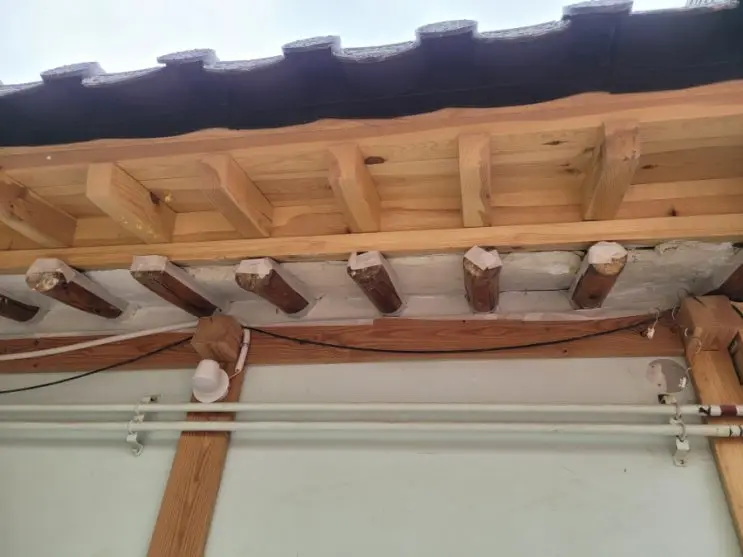
Day seventy-two. The courtyard eaves finished their transformation, and a baking aisle solved a masonry problem.
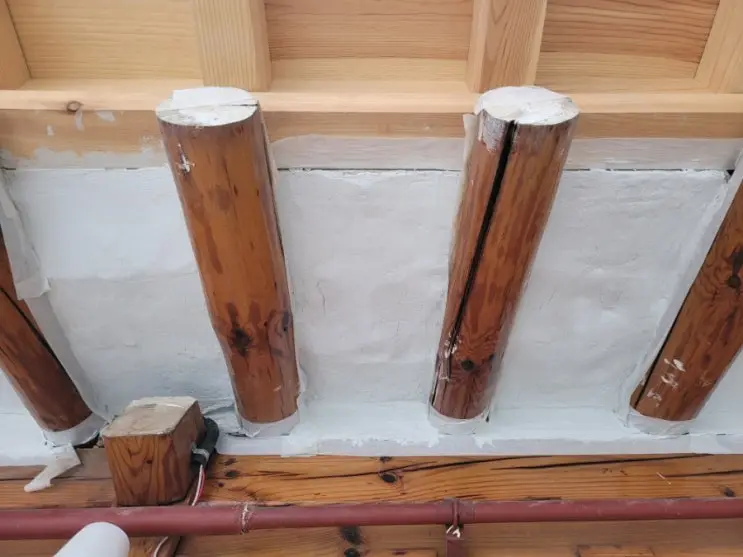
The eaves complete their whites. The courtyard eave campaign concluded: fifteen bays today on top of yesterday’s ten, at a consumption rate now precise enough to publish — one bag of X18 per ten bays. The sequence is second nature: urethane foam into the wiring holes and detached spots, cure, cement, mist, brush. The dangol walls — the small infill panels between rafter seats — took the same treatment, and the courtyard’s ceiling line now reads as rhythmic white bays between dark timber, the signature hanok view restored.
Confirmed en route: exterior plaster cracks more, and worse, than interior — sun and wind are crueler curing partners than a living room. The prescription: stiff peanut-butter mix, spread thin, and hairlines chased afterward with undiluted acrylic filler. Timber housekeeping rules re-earned: stray cement wipes off wood cleanly with a wet rag if caught the same day, and thick masking tape must come off the moment plaster is placed — cured-over tape becomes embedded archaeology.
The piping bag. The facade’s wapyeon band — the black roof-tile fragments set into the walls back in March — had been quietly incomplete: 20% of its joints never got pointed, and some fragments had shed. The narrow, irregular gaps defeat both trowel and gloved finger. Solution from the baking aisle: a disposable piping bag filled with loose-mixed white cement, nozzle into each joint, squeeze a clean bead, then strike it smooth with a thin spatula. Hygienic, precise, and outrageously faster — the pointing that had stalled for weeks finished in an afternoon. Refinement for next time: match the joint width to your spatula when first setting the fragments, and the pointing becomes a two-motion process.
The house’s last exterior rough edges are disappearing one improvised tool at a time.
Originally logged in Korean on May 11, 2026 — read the original. Translated and edited by the brothers who did the work.